
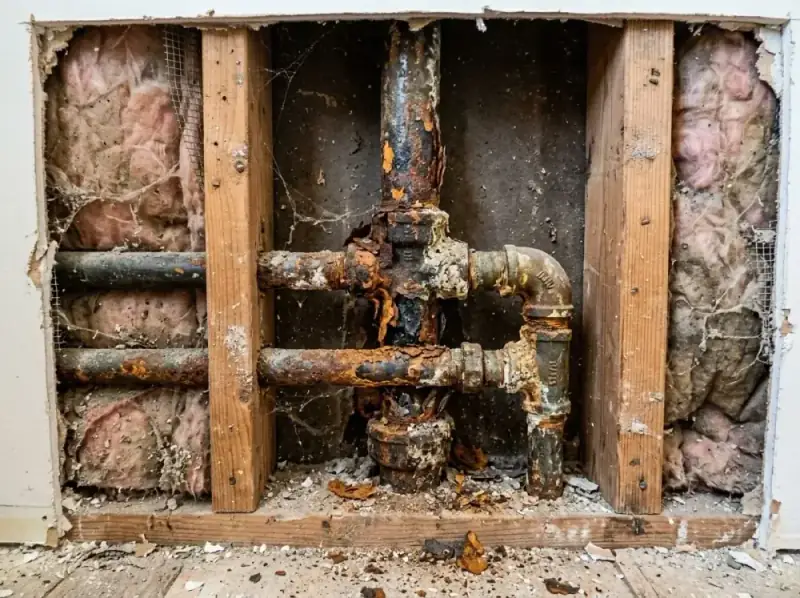
Cast Iron & Galvanized Pipe Failure in Older Santa Ana Homes
If your Santa Ana home was built between 1945 and 1978 in neighborhoods such as Riverview West, South Coast Metro, or East Santa Ana, your plumbing system was likely installed with two materials that have now reached total failure: galvanized steel for fresh water supply lines, and unlined cast iron for drain, waste, and vent (DWV) piping.
These two plumbing systems fail in radically different ways. Galvanized supply pipes corrode from the inside out with rust tubercles that choke water pressure and turn drinking water rust-colored. Meanwhile, cast iron waste pipes suffer bottom-channel corrosion and sulfur-acid rot that allow sewage and sewer gas to escape beneath your floorboards. Replacing both systems simultaneously via an engineered Uponor PEX-a water repipe and ABS/PVC waste pipe replacement eliminates catastrophic water damage risks and restores modern plumbing reliability for decades.
How Cast Iron Waste Pipes Fail: The Channeling Phenomenon
Cast iron has an expected design lifespan of 40 to 60 years in Southern California. The primary failure mechanisms include:
1. Bottom Invert Channeling
Because wastewater rests along the bottom floor of a horizontal drain pipe, sulfuric acid and abrasive grit continuously scour the cast iron invert. Over 50 years, the bottom 1/4-inch of iron corrodes away completely, creating a subterranean trench where sewage leaks beneath your home's foundation slab.
2. Internal Rust Tubercles & Catch Points
As iron oxidizes, it expands up to 10 times its original volume. The interior pipe walls become jagged and encrusted with rough rust flakes that snag toilet paper and solid waste, causing persistent, unresolvable backups.
3. Bell-and-Spigot Lead Joint Separation
Historic cast iron sections were joined using molten lead and braided oakum fiber. Ground shifting from expansive Santa Ana clay soils pulls these joints apart, allowing sewer gas to leak into wall cavities and tree roots to invade.
Why Replace Galvanized Water Lines with Uponor PEX-a?
When upgrading plumbing infrastructure, pairing drain replacement with an Uponor PEX-a potable water repipe is the gold standard:
- Complete Immunity to Corrosion: PEX-a (cross-linked polyethylene) is completely immune to the aggressive pitting corrosion caused by Santa Ana's high-hardness mineral water.
- Shape Memory ProPEX Expansion Fittings: Unlike crimp PEX or copper solder joints, Uponor PEX-a utilizes cold expansion fittings where the tubing shrinks tightly around solid brass or engineered polymer fittings, creating a connection stronger than the pipe itself with zero hidden leak risk.
- High Flow Velocity & Silence: The smooth interior surface eliminates water hammer noise, prevents scale buildup, and maintains optimal 55 to 65 PSI water pressure at every showerhead simultaneously.
- Seismic Flexibility: In earthquake-prone Southern California, flexible PEX-a tubing absorbs ground shock waves without snapping or joint rupture.
Project Roadmap: How We Perform Comprehensive Repiping
Our master plumbers execute whole-home repiping with minimal disruption to your daily routine:
Day 1: Architectural Mapping & Dust Containment
We mask all floors with heavy-duty Ram Board, hang negative-pressure zip-wall plastic barriers, and map clean cutouts in drywall behind fixtures.
Day 2–3: Overhead PEX-a Supply Rerouting
We run new PEX-a main trunk lines through attic joists and drop dedicated lines down through wall cavities, installing quarter-turn solid brass angle stops and braided stainless steel supply lines at every fixture.
Day 3–4: Drainage DWV Pipe Replacement
We replace degraded horizontal cast iron drains with heavy-gauge Schedule 40 ABS or PVC piping, incorporating precision-sloped sanitary sweeps and accessible cleanout plugs.
Day 5: City Inspection, Title 24 Testing & Texture Drywall Patch
We perform hydrostatic pressure testing for the City of Santa Ana building inspector, sign off permits, and seamlessly patch, texture, and blend drywall cutouts to match your existing walls.
Santa Ana Building Code Compliance & Master Plumber Standards
Plumbing work in the City of Santa Ana is governed by the California Plumbing Code (Title 24, Part 5 of the California Code of Regulations) and municipal health amendments enforced by the City of Santa Ana Planning and Building Agency. Whether performing cast iron DWV replacement and Uponor PEX-a repiping, plumbing installations must meet stringent structural, health, and seismic standards.
At Santa Ana Plumber Pros, every technician is directly supervised by a licensed California Master Plumber (CSLB C-36 License #1049821). We hold comprehensive $2,000,000 commercial liability and workers' compensation coverage, ensuring property owners are 100% protected throughout the diagnostic, permitting, and repair process. Key standards enforced on every job include:
- Mandatory City Permitting & Inspection: Potable water repiping and sanitary drain replacement require City of Santa Ana building permits, 100 PSI hydrostatic pressure decay certification, and Title 24 energy-efficient pipe insulation.
- Lead-Free Materials Mandate: In strict compliance with California Health and Safety Code Section 116875 (AB 1953), all potable brass valves, solder fittings, and PEX expansion manifolds installed are third-party certified lead-free with less than 0.25% wetted surface lead content.
- Seismic Restraint & Ground Movement Allowances: Given Orange County's proximity to regional fault lines, all rigid piping runs incorporate flexible braided stainless steel or engineered expansion loops to prevent catastrophic shearing during earth tremors.
- Upfront Flat-Rate Written Proposals: You receive a clear, itemized written proposal before any physical work begins—featuring fixed pricing with zero hidden trip fees, zero portal-to-portal surcharges, and zero overtime penalties 24/7/365.
Frequently Asked Questions
Expert answers from our CSLB-licensed master plumbers on cast iron DWV replacement and Uponor PEX-a repiping:
Why are cast iron waste pipes failing across post-war Santa Ana homes?
Unlined cast iron pipes installed between 1945 and 1975 have an expected lifespan of 40 to 50 years. Domestic wastewater releases hydrogen sulfide gas, which oxidizes into sulfuric acid. This acid eats away the bottom invert of the pipe, causing channeling, floor dampness, and severe rust scale.
Why should I replace fresh water lines and waste lines at the same time?
Combining an Uponor PEX-a water repipe with waste line replacement saves thousands of dollars in shared labor, permits, and drywall restoration. Technicians open drywall cavities once, replace both systems, and perform single-phase city inspection signoffs.
How long can a family stay in their home during a whole-home repipe?
You do not need to move out. Our crews restore running water and operational toilets at the end of each working day, ensuring your family has full domestic plumbing every evening.
Need Code-Compliant Plumbing in Santa Ana?
Direct mobile dispatch across Santa Ana and Orange County. 25–40 minute local arrival with $0 overtime surcharges 24/7/365. CSLB Master Plumber License #1049821.