
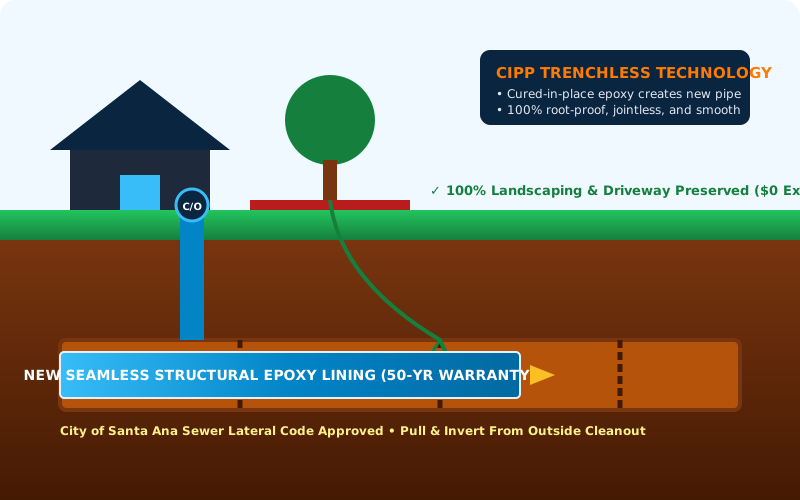
Preserving Historic Santa Ana Architecture with CIPP Sewer Relining
Santa Ana features some of Southern California's finest historic homes. Neighborhoods like Floral Park, French Park, and Morrison Park showcase classic Craftsman bungalows and Spanish Revivals. These properties feature mature 80-year-old trees, custom flagstone paths, and stone masonry walls.
However, beneath these architectural treasures lies a critical challenge: original 100-year-old vitrified clay or unlined cast iron sewer laterals that have succumbed to root penetration, offset bell joints, and ground settlement. For owners of historic properties, traditional trench excavation is unthinkable—it destroys irreplaceable landscaping and risks structural vibration damage to unreinforced foundations. Cured-in-Place Pipe (CIPP) trenchless relining provides the ultimate conservation-friendly solution.
Historic Sewer Vulnerabilities in Santa Ana's Oldest Districts
Historic sewer laterals installed between 1900 and 1960 suffer from specific failure mechanisms:
1. Mortar-Joint Vitrified Clay Pipe (VCP) Degradation
Vitrified clay itself is chemically inert and virtually immune to sewer acid. However, early clay pipe sections were only 2 to 3 feet in length, joined together with oakum packing and crude concrete mortar. Over 70 to 100 years, ground acidity and seismic tremors dissolve the mortar collars, leaving open circular gaps at every 3-foot interval that invite invasive root systems.
2. Sulfur-Acid Corrosion in Pre-War Cast Iron
Cast iron waste pipes installed beneath historic homes were unlined. Over decades, hydrogen sulfide gas produced by wastewater bacteria oxidizes into sulfuric acid. This acid selectively attacks the bottom interior invert of the pipe, causing "channeling" where the pipe floor corrodes completely through, spilling sewage directly into foundation subsoil.
The Conservation Advantage: Zero Landscape or Structural Impact
CIPP relining is uniquely suited for historic Santa Ana conservation:
- Zero Excavation Across Flagstone or Masonry: The entire lining process occurs through an existing exterior cleanout or a small, discrete 2-foot access pit tucked behind boundary shrubbery.
- Protection of Protected Heritage Trees: Excavators frequently sever critical structural roots of protected heritage oaks and camphor trees, causing tree death within 12 months. Trenchless relining passes harmlessly through the root zone without touching a single root branch.
- Preservation of Historic Paving: Historic brick walkways, terracotta tiled courtyards, and pebble-finish driveways remain 100% undisturbed.
Engineering Specifications for Historic CIPP Relining
Relining an aging historic lateral requires specialized equipment and precision:
1. Calibrated Mechanical Descaling
We utilize low-vibration electric descaling machines equipped with flexible carbide flail heads. This gently removes mineral encrustations and calcium deposits without exerting outward percussive force that could fracture brittle antique clay walls.
2. High-Flex Epoxy Liners for Dimensional Irregularities
Historic clay lines frequently transition between 3-inch, 4-inch, and 6-inch diameters as they approach the street main. We engineer multi-dimensional, high-flexibility woven felt sleeves that seamlessly adapt to diameter transitions and navigate 45-degree sweeping bends without wrinkling.
3. Structural ASTM F1216 Compliance
Our cured liners meet ASTM F1216 structural standards for fully deteriorated gravity sewer pipes, creating a stand-alone pipe capable of withstanding full traffic loading (HS-20 highway rating) even if the surrounding host clay pipe collapses entirely.
Santa Ana Building Code Compliance & Master Plumber Standards
Plumbing work in the City of Santa Ana is governed by the California Plumbing Code (Title 24, Part 5 of the California Code of Regulations) and municipal health amendments enforced by the City of Santa Ana Planning and Building Agency. Whether performing historic district trenchless sewer conservation, plumbing installations must meet stringent structural, health, and seismic standards.
At Santa Ana Plumber Pros, every technician is directly supervised by a licensed California Master Plumber (CSLB C-36 License #1049821). We hold comprehensive $2,000,000 commercial liability and workers' compensation coverage, ensuring property owners are 100% protected throughout the diagnostic, permitting, and repair process. Key standards enforced on every job include:
- Mandatory City Permitting & Inspection: All rehabilitation work complies with Santa Ana Historic Preservation Commission guidelines and Title 24 conservation mandates, preserving historic brick, flagstone, and protected heritage trees.
- Lead-Free Materials Mandate: In strict compliance with California Health and Safety Code Section 116875 (AB 1953), all potable brass valves, solder fittings, and PEX expansion manifolds installed are third-party certified lead-free with less than 0.25% wetted surface lead content.
- Seismic Restraint & Ground Movement Allowances: Given Orange County's proximity to regional fault lines, all rigid piping runs incorporate flexible braided stainless steel or engineered expansion loops to prevent catastrophic shearing during earth tremors.
- Upfront Flat-Rate Written Proposals: You receive a clear, itemized written proposal before any physical work begins—featuring fixed pricing with zero hidden trip fees, zero portal-to-portal surcharges, and zero overtime penalties 24/7/365.
Frequently Asked Questions
Expert answers from our CSLB-licensed master plumbers on historic district trenchless sewer conservation:
Will CIPP relining damage historic flagstone or heritage trees in Floral Park?
No. CIPP relining is 100% non-invasive. The entire installation takes place through a small exterior cleanout or discrete access point. Historic hand-laid flagstone, brick pavers, and the root networks of heritage oak and camphor trees remain completely undisturbed.
Does the City of Santa Ana Historic Preservation Commission permit CIPP relining?
Yes. CIPP lining is favored by municipal historic preservation guidelines because it rehabilitates underground infrastructure without altering the historic facade, paving, or landscaping of designated historic structures.
How do you handle branch bathroom connections inside a lined pipe?
After the liner cures, we navigate a specialized robotic micro-cutter equipped with an onboard camera through the line. The robotic diamond bit precision-mills out the exact circular openings for all incoming branch connections, restoring full flow.
Need Code-Compliant Plumbing in Santa Ana?
Direct mobile dispatch across Santa Ana and Orange County. 25–40 minute local arrival with $0 overtime surcharges 24/7/365. CSLB Master Plumber License #1049821.