Santa Ana's Hard Water Crisis: 18+ GPG Mineral Damage
Turn on any kitchen or bathroom faucet in Santa Ana, and you are receiving water sourced from the Orange County Water District (OCWD) groundwater basin combined with imported supplies from the Colorado River and State Water Project. While this water is safe to drink, it carries one of the highest concentrations of dissolved mineral rock in North America. Testing in Santa Ana neighborhoods consistently records water hardness levels between 16 and 24 grains per gallon (GPG), or 280 to 410 parts per million (PPM).
According to the Water Quality Association (WQA), any water measurement exceeding 10.5 GPG is classified as "Very Hard." At 18+ GPG, Santa Ana water is extraordinarily destructive to residential plumbing systems, appliances, and fixtures. Over a single year, a typical family of four circulates over 150 pounds of dissolved limestone rock through their home's plumbing. This comprehensive guide details the real hidden financial and structural costs of hard water in Santa Ana and how to protect your investment.
The Cost of Hard Water on Residential Fixtures & Appliances
1. Water Heater Burnout & 30% Efficiency Loss
Water heating is the primary target of hard water destruction. As water temperatures climb above 120°F, dissolved calcium and magnesium precipitate out of solution, coating internal heating elements and tank floors with rock-hard scale (calcite). A 3/8-inch layer of scale acts like firebrick insulation, reducing heating efficiency by up to 30%, driving up gas bills by $150 to $300 annually, and causing premature tank rupture in just 5 to 7 years instead of the standard 12-year lifespan.
2. Shower Cartridge & Valve Destruction
Ever wonder why your shower handle becomes stiff and difficult to turn after only two years? Mineral scale forms inside brass shower valve balancing spools and ceramic disc cartridges. The abrasive grit scores rubber O-rings, leading to continuous dripping and requiring frequent $200 to $350 valve cartridge replacements.
3. Constricted Copper Pipe Diameters
Inside copper water supply lines, hard water minerals bond with copper oxides to form rough, chalky internal lining. Over 15 to 25 years, a 3/4-inch main distribution line is constricted down to the flow diameter of a pencil, creating frustrating pressure drops whenever a toilet is flushed while someone is showering.
4. Dishwasher & Laundry Machine Deterioration
Modern high-efficiency appliances use less water, meaning mineral concentrations inside dishwashers and clothes washers are higher than ever. Hard water leaves cloudy white film on glassware, stiffens clothing fabrics, and destroys internal solenoid fill valves, pump impellers, and heating coils.
Financial Impact: The True Annual Cost of Hard Water
The Solution: High-Efficiency Whole-House Ion Exchange
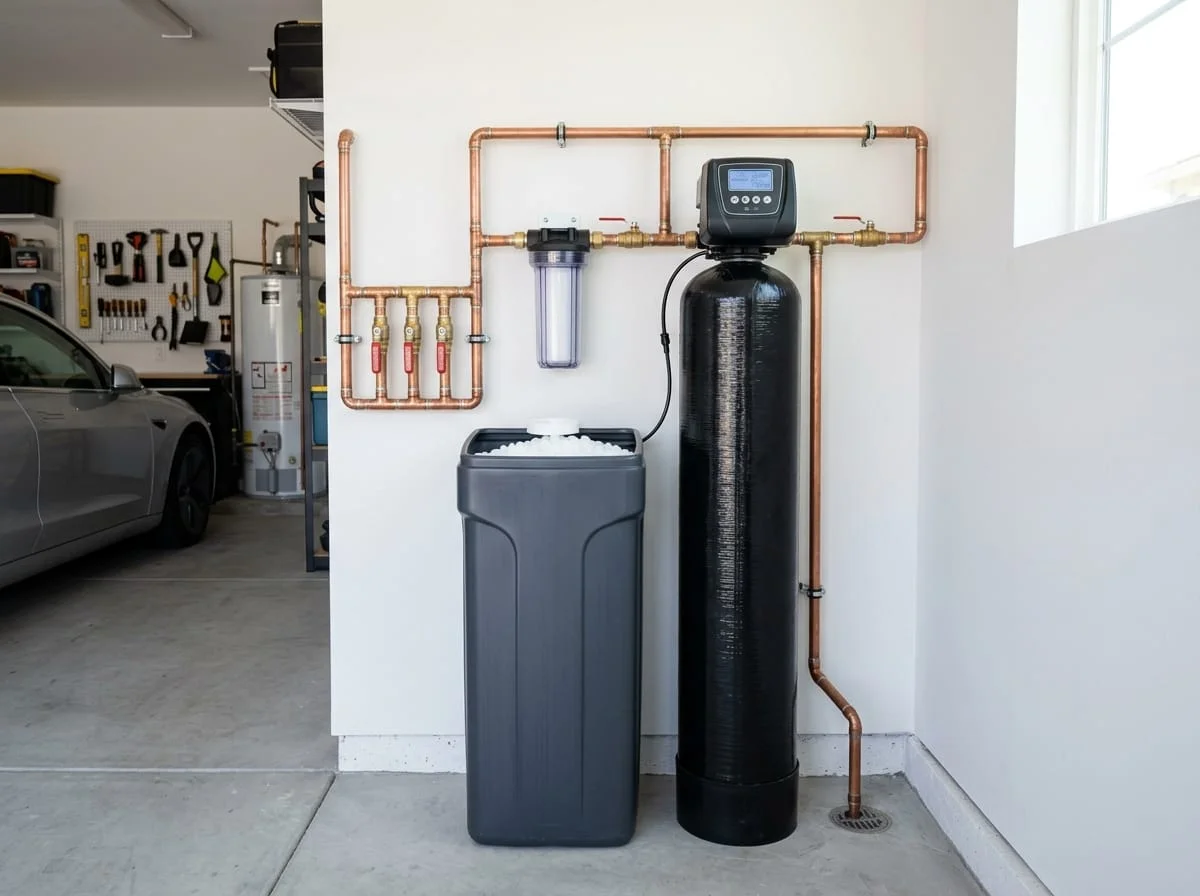
The only scientifically proven method to completely remove calcium and magnesium ions from residential water supplies is high-efficiency ion exchange water softening. Unfiltered water flows through a resin tank packed with millions of microscopic polystyrene sulfonate beads charged with sodium or potassium ions. As hard water passes over the beads, calcium and magnesium ions physically bind to the resin, releasing harmless sodium ions in a process known as cation exchange.
Modern demand-regenerated softeners feature digital water meter monitoring, only regenerating when water volume dictates, conserving water and reducing salt usage by up to 45% compared to legacy timer-based softeners.
Santa Ana Building Code Compliance & Master Plumber Standards
Plumbing work in the City of Santa Ana is governed by the California Plumbing Code (Title 24, Part 5 of the California Code of Regulations) and municipal health amendments enforced by the City of Santa Ana Planning and Building Agency. Whether performing water softener installation and scale mitigation, plumbing installations must meet stringent structural, health, and seismic standards.
At Santa Ana Plumber Pros, every technician is directly supervised by a licensed California Master Plumber (CSLB C-36 License #1049821). We hold comprehensive $2,000,000 commercial liability and workers' compensation coverage, ensuring property owners are 100% protected throughout the diagnostic, permitting, and repair process. Key standards enforced on every job include:
- Mandatory City Permitting & Inspection: Water treatment installations comply with California Health and Safety Code Section 116785 regulations on residential water softening systems, including approved air-gap drain discharge connections.
- Lead-Free Materials Mandate: In strict compliance with California Health and Safety Code Section 116875 (AB 1953), all potable brass valves, solder fittings, and PEX expansion manifolds installed are third-party certified lead-free with less than 0.25% wetted surface lead content.
- Seismic Restraint & Ground Movement Allowances: Given Orange County's proximity to regional fault lines, all rigid piping runs incorporate flexible braided stainless steel or engineered expansion loops to prevent catastrophic shearing during earth tremors.
- Upfront Flat-Rate Written Proposals: You receive a clear, itemized written proposal before any physical work begins—featuring fixed pricing with zero hidden trip fees, zero portal-to-portal surcharges, and zero overtime penalties 24/7/365.
Frequently Asked Questions
Expert answers from our CSLB-licensed master plumbers on water softener installation and scale mitigation:
How hard is the municipal water in Santa Ana?
Santa Ana water tests between 16 and 24 grains per gallon (GPG), or 280 to 410 parts per million (PPM) of dissolved calcium and magnesium. Any reading above 10.5 GPG is classified by the Water Quality Association as "Very Hard".
Does a whole-house water softener eliminate hard water spots on glass and fixtures?
Yes. High-efficiency ion exchange water softeners remove 99%+ of dissolved calcium and magnesium ions, eliminating white chalky scale from shower glass, chrome faucets, and dishware.
Are salt-free water conditioners as effective as ion-exchange softeners?
Salt-free conditioners (Template Assisted Crystallization) alter mineral crystalline structure to reduce scale adherence inside hot pipes, but they do not physically remove minerals from the water. Only ion exchange softeners deliver true soft water that lathers instantly and protects plumbing.
Need Code-Compliant Plumbing in Santa Ana?
Direct mobile dispatch across Santa Ana and Orange County. 25–40 minute local arrival with $0 overtime surcharges 24/7/365. CSLB Master Plumber License #1049821.