
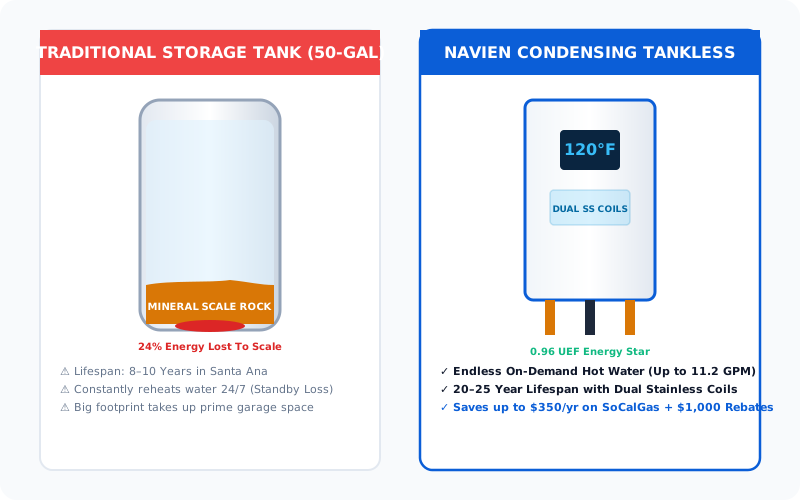
Diagnosing Water Heater Failures in Santa Ana Properties
Stepping into the shower on a chilly morning only to be greeted by an icy blast of water is an unpleasant shock. For Santa Ana homeowners, water heater failures are rarely sudden accidents; they are the predictable result of local municipal water chemistry, aging gas components, and intense mineral scaling. In Orange County, where municipal tap water delivers an aggressive 16 to 22 grains of dissolved calcium and magnesium per gallon, standard residential water heaters face severe operational stress that reduces their effective design lifespan to just 6 to 10 years without proactive maintenance.
Whether you own a conventional atmospheric gas storage tank, an ultra-low NOx power vent unit, an electric resistance heater, or a high-efficiency tankless system, identifying the exact root cause of failure saves hundreds of dollars in unnecessary part replacements. This diagnostic guide walks you through the mechanical, thermal, and electrical causes of water heater failure and outlines safe, code-compliant solutions.
Primary Causes of Water Heater Outages in Santa Ana
1. Severe Mineral Sediment Calcification
When hard municipal water is heated above 120°F, dissolved calcium carbonate precipitates out of solution and settles as dense, rock-hard calcified sediment at the bottom of the tank. In a gas water heater, this mineral layer forms a 2-inch to 4-inch insulating blanket directly between the bottom burner flame and the water. This leads to overheating of the glass-lined steel tank bottom, chronic popping and rumbling noises (kettling), delayed thermal heat transfer, and premature tank rupture.
2. Thermocouple & Flame Sensor Malfunction
The thermocouple is a thermoelectric safety sensor that generates a minute millivolt electrical current when heated by the standing pilot flame. If the pilot goes out, the thermocouple cools, shutting off the electromagnetic gas valve to prevent unburned natural gas from accumulating inside your home. Over years, carbon soot and copper oxide coat the thermocouple tip, preventing it from sensing heat even when the pilot is burning, causing the pilot to shut down immediately after releasing the control knob.
3. Electronic Ignition & Spark Igniter Failure
Modern Title 24 compliant Ultra-Low NOx water heaters utilize electronic hot-surface igniters or piezoelectric spark modules. Electrical surges, failed capacitor boards, or cracked ceramic igniter rods will prevent the unit from initiating combustion, displaying blinking diagnostic error codes on the Honeywell status indicator.
4. Failed Upper or Lower Electric Heating Elements
In electric water heaters, two submerged resistance elements (upper and lower) heat the water. Mineral scale acts like thermal insulation around the elements; trapped heat cannot dissipate into the water, causing the heating coil inside the incoloy sheath to overheat and burn out within minutes.
5. Temperature & Pressure (T&P) Relief Valve Leakage
The T&P relief valve is the ultimate mechanical safety device on your water heater, calibrated to discharge water if internal pressure exceeds 150 PSI or temperature exceeds 210°F. If the valve continuously drips or discharges violently, your home either has excessive municipal water pressure (above 80 PSI), a failed thermal expansion tank, or a malfunctioning internal thermostat.
Homeowner Diagnostic Checklist: Safe Troubleshooting
Before contacting a licensed technician, perform these safe visual diagnostic checks:
- Check the Pilot Sight Glass: Look through the small glass viewing port at the bottom of the tank. If no small blue flame is visible, the pilot light has extinguished.
- Inspect the Gas Supply Valve: Ensure the yellow or red manual gas shutoff valve handle is positioned parallel to the gas pipe (fully open position).
- Observe Honeywell Gas Valve LED Flash Code: Modern water heaters feature a flashing status light. One heartbeat flash every 3 seconds indicates normal operation; specific 2, 4, or 5-flash sequences indicate failed sensors or thermal cutoff switch trips.
- Check Main Electrical Breaker: For electric or tankless units, inspect your main electrical service panel to ensure the 30-amp or 40-amp dual-pole breaker has not tripped.
Repair vs. Replacement Decision Guide
Santa Ana Title 24 & Seismic Safety Standards
In California, installing a replacement water heater requires strict compliance with City of Santa Ana building codes and Title 24 energy efficiency mandates:
- California Double Seismic Strapping: The water heater must be secured with two heavy-gauge steel earthquake straps bolted into structural wall framing studs (one in the upper third and one in the lower third of the tank).
- Thermal Expansion Tank: When cold water is heated, it expands in volume by 2% to 3%. A pre-pressurized thermal expansion tank must be installed on the cold supply line to absorb this hydraulic surge.
- Full-Port Solid Brass Ball Shutoff: A dedicated quarter-turn ball valve must be installed on the cold inlet line for emergency shutoff.
- Sediment Trap (Drip Leg): A minimum 3-inch vertical pipe nipple installed at the gas control inlet to catch pipe shavings and moisture before they reach the gas valve orifice.
Santa Ana Building Code Compliance & Master Plumber Standards
Plumbing work in the City of Santa Ana is governed by the California Plumbing Code (Title 24, Part 5 of the California Code of Regulations) and municipal health amendments enforced by the City of Santa Ana Planning and Building Agency. Whether performing water heater diagnostics, repair, and replacement, plumbing installations must meet stringent structural, health, and seismic standards.
At Santa Ana Plumber Pros, every technician is directly supervised by a licensed California Master Plumber (CSLB C-36 License #1049821). We hold comprehensive $2,000,000 commercial liability and workers' compensation coverage, ensuring property owners are 100% protected throughout the diagnostic, permitting, and repair process. Key standards enforced on every job include:
- Mandatory City Permitting & Inspection: Water heater installations require California double seismic earthquake strapping, a dedicated thermal expansion tank, sediment trap drip leg, and city building inspector combustion verification.
- Lead-Free Materials Mandate: In strict compliance with California Health and Safety Code Section 116875 (AB 1953), all potable brass valves, solder fittings, and PEX expansion manifolds installed are third-party certified lead-free with less than 0.25% wetted surface lead content.
- Seismic Restraint & Ground Movement Allowances: Given Orange County's proximity to regional fault lines, all rigid piping runs incorporate flexible braided stainless steel or engineered expansion loops to prevent catastrophic shearing during earth tremors.
- Upfront Flat-Rate Written Proposals: You receive a clear, itemized written proposal before any physical work begins—featuring fixed pricing with zero hidden trip fees, zero portal-to-portal surcharges, and zero overtime penalties 24/7/365.
Frequently Asked Questions
Expert answers from our CSLB-licensed master plumbers on water heater diagnostics, repair, and replacement:
Why does my water heater pilot light keep going out?
The most common cause is a defective thermocouple or dirty flame sensor. If carbon soot or mineral oxidation coats the sensor tip, it cannot generate the 20 to 30 millivolts required to hold the electromagnetic gas valve open, causing the pilot to shut off as soon as you release the control knob.
What does popping or rumbling noise from my water heater mean?
Popping or rumbling (kettling) is caused by severe calcium sediment buildup. Water trapped beneath the mineral layer boils into steam bubbles that pop violently against the tank bottom. This causes localized metal overheating and premature tank rupture.
How long do water heaters last in Santa Ana?
Due to Santa Ana’s extreme 18+ GPG hard water, unsoftened conventional water heaters last only 6 to 8 years before mineral calcification destroys the tank or elements. With a whole-house water softener and annual flushing, life expectancy doubles to 12 to 15 years.
Need Code-Compliant Plumbing in Santa Ana?
Direct mobile dispatch across Santa Ana and Orange County. 25–40 minute local arrival with $0 overtime surcharges 24/7/365. CSLB Master Plumber License #1049821.