
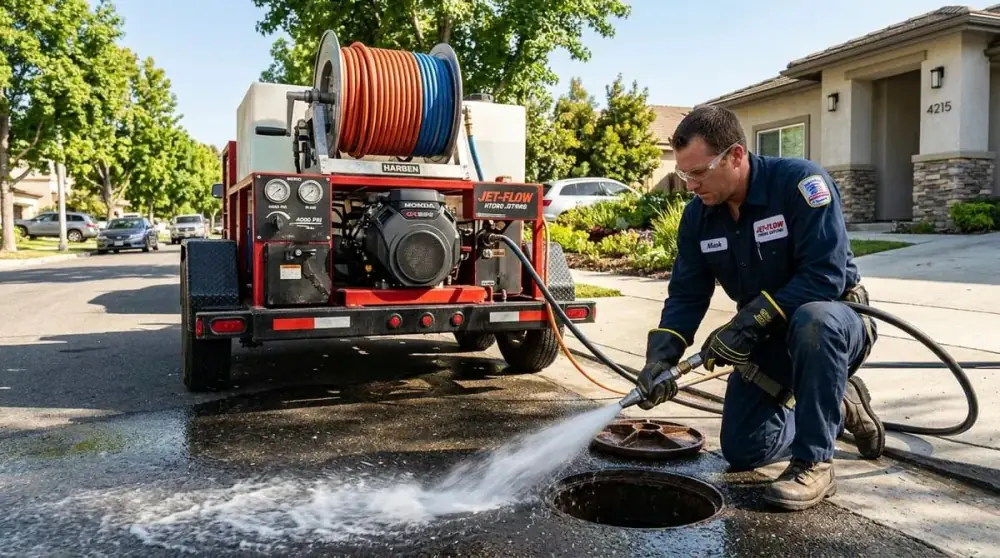
The Battle for Your Sewer Lateral: Hydro Jetting vs. Snaking
When your toilets gurgle, your showers back up, or sewage pushes up through an exterior patio drain, you are facing a stoppage in your building sewer lateral. For Santa Ana homeowners, this problem is frequently caused by aggressive tree roots seeking moisture inside underground clay or cast iron piping. Faced with an emergency backup, property owners must choose between traditional mechanical snaking and high-pressure 4,000 PSI hydro jetting.
While mechanical snaking has been the plumbing standard since the 1930s, modern hydro-jetting technology provides an entirely different level of pipe restoration. Choosing the wrong method can leave thick root mats and congealed fats lining the interior pipe walls, guaranteeing that your sewer will back up again within 90 days. This comprehensive guide outlines the technical differences, safety protocols, and Santa Ana cost factors between both solutions.
How Tree Roots Invade Santa Ana Sewer Pipes
Understanding why roots target your sewer lines explains why traditional mechanical snaking rarely provides a permanent solution:
1. Soil Moisture Gradients
Orange County experiences long periods of drought followed by concentrated winter rains. During dry summer and autumn months, soil moisture around homes drops precipitously. However, your underground sewer lateral operates at near-100% relative humidity, releasing warm moisture vapor through porous mortar joints, rubber couplings, or minute hairline cracks.
2. Capillary Root Attraction & Inversion
Subterranean root tips are equipped with hydro-tropism receptors that grow toward moisture gradients. Once a single microscopic root hair penetrates a slip-joint, it encounters a nutrient bath of nitrogen, potassium, and phosphates. The root tip rapidly expands, multiplying into thousands of interwoven fibers that create a dense, woody plug capable of breaking solid clay pipe walls.
The Mechanical Snake: How It Works and When to Use It
A motorized rooter machine drives a flexible, spring-wound steel cable equipped with a specialized cutting blade (such as a spade head, spiral retriever, or expanding C-cutter) into the drain line:
Advantages of Cabling:
- Immediate Flow Relief: In an active emergency where raw sewage is backing up into bathtubs, a mechanical snake punches a 2-inch to 3-inch relief hole through the core obstruction in minutes.
- Retrieval of Foreign Objects: If a toy, small bottle, or hand towel has been accidentally flushed, the corkscrew retriever head can latch onto the physical object and pull it out of the line.
- Lower Upfront Price Point: Mechanical snaking requires less setup and equipment than high-pressure water pumps, making it a cost-effective emergency choice ($95–$250).
Disadvantages of Cabling:
- Incomplete Cleaning: A 2-inch cutter head inside a 4-inch pipe only creates a narrow tunnel through the center of a root mass. It leaves 60% of the roots clinging tightly to the perimeter pipe walls.
- No Grease Removal: Pushing a mechanical cable through congealed grease simply punches a hole through soft butter; as soon as the cable withdraws, the grease reseals behind it.
- Risk to Brittle Clay Pipes: The whipping motion of a heavy steel cable can crack aging clay slip-joints or puncture fragile corroded cast iron bottoms.
4,000 PSI Hydro Jetting: The Engineered Scouring Process
Hydro jetting utilizes an industrial commercial triplex pump that pressurizes water up to 4,000 pounds per square inch (PSI) at a flow rate of 8 to 12 gallons per minute (GPM). Delivered through a high-strength thermoplastic hose equipped with forward-facing laser jets and rear-propelling reverse nozzles, hydro jetting performs full 360-degree pipe surface scouring:
1. Forward Laser Piercing
Forward-firing streams slice through solid root blockages and calcified scale like high-pressure industrial saws, emulsifying grease and dislodging trapped debris.
2. 360-Degree Reverse Propulsion
Multiple rear-facing water jets propel the nozzle forward into the pipe while scouring every square millimeter of the pipe circumference. It strips tree roots down to the root collar at the pipe joint and washes grease slurry downstream into the city sewer main.
3. Descaling Cast Iron Pipe Walls
Specially calibrated chain-flail and rotating carbide jetter heads knock off heavy rust scale and calcium nodules, restoring cast iron piping to a smooth hydraulic surface.
Comprehensive Feature Comparison Matrix
When Is Hydro Jetting Safe for Older Pipes?
A common concern among Santa Ana homeowners is whether 4,000 PSI water pressure will damage fragile 1950s pipes. The answer lies in professional pre-inspection:
Mandatory Pre-Jetting Camera Inspection
At Santa Ana Plumber Pros, our licensed plumbers never introduce a hydro-jetting nozzle into an unverified pipe. We conduct a complete camera inspection first to assess the structural integrity of the sewer walls. If the pipe has sustained structural collapse, missing bottom invert, or severe shearing, high-pressure jetting is contraindicated, and trenchless CIPP lining or pipe bursting is recommended instead.
Pressure Modulation by Pipe Material
We calibrate operating water pressures based on the piping material:
- Cast Iron & ABS Piping: 3,500 to 4,000 PSI for aggressive scale flailing and root shearing.
- Vitrified Clay Pipe (VCP): 2,800 to 3,200 PSI with specialized rotating root cutters to preserve clay bell joints.
- Corrugated Drainage Pipe: 1,500 to 2,000 PSI to clear silt and gravel without puncturing flexible plastic ridges.
Frequently Asked Questions About Hydro Jetting
How often should a residential sewer lateral be hydro-jetted?
For homes with mature trees and historic clay sewer pipes, preventative hydro jetting every 18 to 24 months eliminates roots before they cause a catastrophic sewage backup. For commercial food service properties, quarterly or bi-annual jetting is required by municipal FOG ordinances.
Will hydro jetting eliminate bad sewer smells in my yard?
Yes. Foul sewer odors around patio drains and vents are caused by anaerobic bacterial decomposition of trapped grease, hair, and organic matter. By scouring pipe walls down to the bare substrate, hydro jetting removes the organic food source that produces hydrogen sulfide gas.
Santa Ana Building Code Compliance & Master Plumber Standards
Plumbing work in the City of Santa Ana is governed by the California Plumbing Code (Title 24, Part 5 of the California Code of Regulations) and municipal health amendments enforced by the City of Santa Ana Planning and Building Agency. Whether performing 4,000 PSI high-pressure hydro jetting, plumbing installations must meet stringent structural, health, and seismic standards.
At Santa Ana Plumber Pros, every technician is directly supervised by a licensed California Master Plumber (CSLB C-36 License #1049821). We hold comprehensive $2,000,000 commercial liability and workers' compensation coverage, ensuring property owners are 100% protected throughout the diagnostic, permitting, and repair process. Key standards enforced on every job include:
- Mandatory City Permitting & Inspection: Hydro jetting operations comply with municipal wastewater discharge guidelines, ensuring emulsified fats, oils, and grease (FOG) meet city pretreatment effluent requirements before reaching public sewer mains.
- Lead-Free Materials Mandate: In strict compliance with California Health and Safety Code Section 116875 (AB 1953), all potable brass valves, solder fittings, and PEX expansion manifolds installed are third-party certified lead-free with less than 0.25% wetted surface lead content.
- Seismic Restraint & Ground Movement Allowances: Given Orange County's proximity to regional fault lines, all rigid piping runs incorporate flexible braided stainless steel or engineered expansion loops to prevent catastrophic shearing during earth tremors.
- Upfront Flat-Rate Written Proposals: You receive a clear, itemized written proposal before any physical work begins—featuring fixed pricing with zero hidden trip fees, zero portal-to-portal surcharges, and zero overtime penalties 24/7/365.
Frequently Asked Questions
Expert answers from our CSLB-licensed master plumbers on 4,000 PSI high-pressure hydro jetting:
Can 4,000 PSI hydro jetting damage older clay or cast iron pipes?
When performed by a licensed master plumber who conducts a pre-jetting HD fiber-optic camera survey, hydro jetting is completely safe. We inspect the structural wall integrity first and calibrate operating water pressure between 2,800 and 4,000 PSI depending on the pipe age and material. Hydro jetting uses water velocity rather than percussive metal blades, making it gentler on pipe walls than heavy spinning steel cables.
How often should a home or business have its main sewer line hydro-jetted?
For residential properties with mature trees in neighborhoods like Floral Park or Riverview West, preventative hydro jetting every 18 to 24 months eliminates roots before they trigger an emergency sewage backup. For commercial food service properties and restaurants, Santa Ana municipal FOG ordinances mandate hydro jetting every 3 to 6 months.
What is the difference between a residential jetter and commercial trailer jetters?
Portable electric jetters produce only 1,500 PSI at 2 GPM—sufficient only for small 1.5-inch kitchen lines. Our commercial truck-mounted trailer jetters generate 4,000 PSI at 10 to 12 GPM, producing the intense hydraulic mass needed to slice 4-inch tree root bundles and scour calcified cast iron main sewer laterals clean.
Need Code-Compliant Plumbing in Santa Ana?
Direct mobile dispatch across Santa Ana and Orange County. 25–40 minute local arrival with $0 overtime surcharges 24/7/365. CSLB Master Plumber License #1049821.