
7 Critical Warning Signs Your Santa Ana Sewer Lateral Is Failing
Your main sewer lateral is the single most critical subterranean pipe on your property. Every gallon of wastewater discharged from your toilets, showers, washing machine, and kitchen sink flows through this 3-inch or 4-inch conduit into the City of Santa Ana municipal sewer main under the street. Because the lateral is buried 3 to 8 feet underground, structural deterioration happens silently for years before a catastrophic raw sewage backup floods your home.
In Santa Ana neighborhoods built between 1940 and 1980—such as Delhi, South Coast Metro, and Central Santa Ana—hundreds of homes rely on deteriorating vitrified clay or unlined cast iron pipes that have exceeded their useful lifespan. Recognizing early warning signs enables proactive trenchless repair, saving homeowners $10,000 to $30,000 in emergency water restoration and structural repairs.
Warning Sign 1: Multiple Gurgling Fixtures Simultaneously
If your toilet makes a distinct glugging or bubbling sound when your washing machine drains, or if water rises into the shower stall when you flush, your main sewer line is restricted. When wastewater cannot freely exit into the street main, it displaces trapped air inside the sewer line. That pressurized air forces its way up through the lowest plumbing trap seals in your home, creating audible bubbling and gurgling.
Warning Sign 2: Recurring Drain Clogs Across Independent Rooms
A single clogged bathroom sink is typically a localized blockage caused by toothpaste and hair inside the P-trap. However, when the kitchen sink, master bath toilet, and hallway bathtub all drain sluggishly at the same time, the restriction is not localized; it is located downstream in the main building lateral. Using chemical drain cleaners in this situation only corrodes your piping while failing to clear the obstruction.
Warning Sign 3: Persistent Sewer Gas Odors in Yard or Bathrooms
A functioning sewer system is entirely airtight. Drain traps hold water barriers to block subterranean sewer gases, while roof vents vent air safely above your roofline. If you detect the characteristic "rotten egg" smell of hydrogen sulfide in your yard, crawlspace, or around baseboards, your sewer line has suffered a cracked wall, detached joint, or broken wax seal. Sewer gas is not only unpleasant; it carries methane and airborne pathogens that pose serious respiratory hazards.
Warning Sign 4: An Abnormally Lush, Vibrant Green Patch of Lawn
Have you noticed a strip of grass in your front yard that remains thick, dark green, and fast-growing even during hot summer dry spells? Raw domestic sewage is rich in nitrogen, phosphorus, and moisture—the exact ingredients in commercial fertilizers. A cracked subterranean clay pipe continuously leaks nutrient-dense effluent into the surrounding soil, fertilizing surface turf from beneath.
Warning Sign 5: Ground Indentations, Paver Settlement, or Sinkholes
As sewage leaks out of a cracked pipe, it creates a hydraulic vacuum that draws surrounding soil and bedding sand into the pipe stream (a process known as soil washing). Over months, this continuous erosion excavates an underground void. Eventually, the asphalt driveway, brick patio pavers, or lawn above the pipe collapses inward, creating noticeable depressions or sinkholes.
Warning Sign 6: Unexplained Spikes in Fruit Flies or Drain Flies
Drain flies (moth flies) breed exclusively in decaying organic matter and moist sewage biofilm. If drain flies persist despite regular cleaning, they are likely nesting and multiplying inside a broken subterranean sewer line and migrating upward through fixture vents.
Warning Sign 7: Mold Growth Along Lower Interior Baseboards
In homes built on concrete slab foundations (common throughout post-WWII Santa Ana), a ruptured sewer line beneath the slab saturates the gravel bedding. Capillary action draws sewage moisture up through the porous concrete floor, warping hardwood floors, staining tile grout lines, and fostering black mold growth along lower drywall baseboards.
Diagnostic Action Plan: What to Do If You Spot These Signs
If you observe any combination of these warning signs, take immediate protective action:
1. Cease High-Volume Water Usage
Immediately refrain from running the clothes washer, dishwasher, or long showers. Reducing wastewater flow prevents the pipe from exceeding its restricted carrying capacity and spilling onto finished flooring.
2. Schedule a High-Definition Sewer Camera Survey
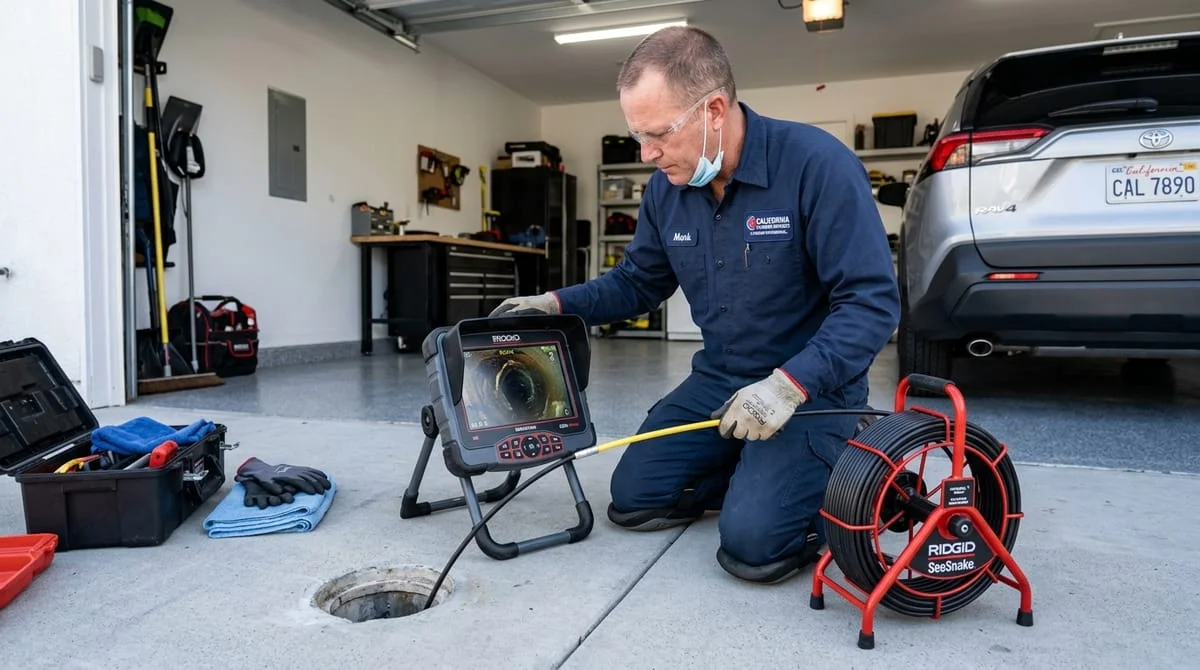
Do not permit any contractor to dig up your yard based on guesswork. A certified C-36 master plumber will feed a self-leveling HD camera with an electronic locating sonde through your cleanout to provide visual proof of the pipe interior, pinpointing the exact depth, location, and nature of the defect.
3. Evaluate Trenchless CIPP vs. Pipe Bursting Solutions
If structural cracking or root intrusion is discovered, modern trenchless technology allows us to rehabilitate the line without trenching across your driveway or destroying historic landscaping.
Santa Ana Building Code Compliance & Master Plumber Standards
Plumbing work in the City of Santa Ana is governed by the California Plumbing Code (Title 24, Part 5 of the California Code of Regulations) and municipal health amendments enforced by the City of Santa Ana Planning and Building Agency. Whether performing sewer lateral inspection and structural diagnostics, plumbing installations must meet stringent structural, health, and seismic standards.
At Santa Ana Plumber Pros, every technician is directly supervised by a licensed California Master Plumber (CSLB C-36 License #1049821). We hold comprehensive $2,000,000 commercial liability and workers' compensation coverage, ensuring property owners are 100% protected throughout the diagnostic, permitting, and repair process. Key standards enforced on every job include:
- Mandatory City Permitting & Inspection: Fiber-optic camera inspections and pipe diagnostics align with California Plumbing Code Chapter 7 sanitary drainage standards, certifying proper self-scouring minimum 1/4-inch per foot fall.
- Lead-Free Materials Mandate: In strict compliance with California Health and Safety Code Section 116875 (AB 1953), all potable brass valves, solder fittings, and PEX expansion manifolds installed are third-party certified lead-free with less than 0.25% wetted surface lead content.
- Seismic Restraint & Ground Movement Allowances: Given Orange County's proximity to regional fault lines, all rigid piping runs incorporate flexible braided stainless steel or engineered expansion loops to prevent catastrophic shearing during earth tremors.
- Upfront Flat-Rate Written Proposals: You receive a clear, itemized written proposal before any physical work begins—featuring fixed pricing with zero hidden trip fees, zero portal-to-portal surcharges, and zero overtime penalties 24/7/365.
Frequently Asked Questions
Expert answers from our CSLB-licensed master plumbers on sewer lateral inspection and structural diagnostics:
Why does my toilet bubble when I run the washing machine or shower?
Bubbling toilets indicate that air is trapped inside the drainage system by a downstream mainline sewer obstruction. As the washing machine pump discharges high water volume, the water pushes against the blockage, pressurizing the trapped air. That air escapes through the path of least resistance—your toilet trap seal.
Can a broken sewer line cause foundation problems in Santa Ana?
Yes. Santa Ana soil consists of expansive alluvial clay. A leaking sewer lateral saturates the soil beneath your foundation slab, causing localized soil swelling (heaving) that cracks concrete foundations, warps hardwood flooring, and causes interior doors to bind.
Who is legally responsible for the sewer lateral under the street?
Under City of Santa Ana municipal regulations, the private property owner is legally responsible for the maintenance and structural integrity of the entire private sewer lateral—from the exterior house wall all the way to the connection (wye/saddle) at the city main under the street.
Need Code-Compliant Plumbing in Santa Ana?
Direct mobile dispatch across Santa Ana and Orange County. 25–40 minute local arrival with $0 overtime surcharges 24/7/365. CSLB Master Plumber License #1049821.